

INTRODUCTION
You probably must be reading this newsletter on your phone or a laptop, just like everyone else, but why am I pointing this out?
Nothing, just trying to make a sassy intro to my newsletter to engage audience until the end, otherwise, people won’t stay up till the end, making the whole effort a waste.
JUST KIDDING (or am I)!!!!
Isn’t every company nowadays about manipulating user engagement or about forming habit-building products?
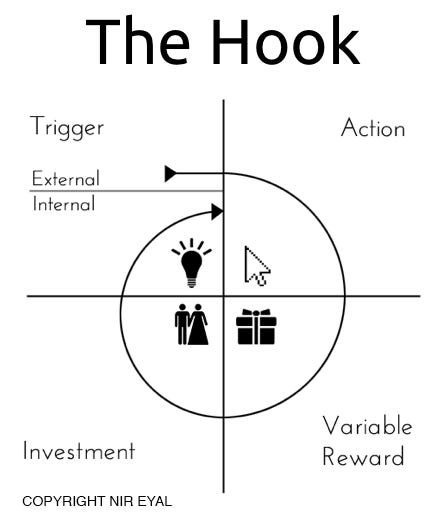
This is exactly what today’s topic is about, you can think of it as my documentation of diving deep into product design and behavioral psychology.
WHY HABITS ARE GOOD FOR BUSINESS?
A simple yet complicated set of sub-questions that people wouldn’t come across if they haven’t thought about it deeply.
Every business nowadays wants a loyal customer base that gives them revenue for a lifetime, isn’t it something that we all want to have?
But, why is it so important?
Can we not grow a successful business without habit-forming products?
What if our service or product is something you cannot get habituated with?
Yes, you can, but I am not here to present my views and learning about the otherwise possible outcome, I am writing this newsletter to share with you how to achieve those things.
INCREASING CUSTOMER LIFETIME VALUE
The first trick that I have learned about and which you can implement is to increase the value that you provide to the customer with time.
From a psychological perspective, not only will this make your customer feel happy about themselves, but also it will give them a sense of importance which we humans crave for.
Providing an increasing value to customers, lifetime, will not only increase your revenue from that single customer, but will also build a habit for him/her to use your product.
PROVIDING PRICING FLEXIBILITY
When Building a product that is already there in the market, the only war that people can look forward to is the price war, with their competitors.
But doesn’t this show, our lack of innovation and quality?
Yes, it does sometimes, but the price war I am referring to here is completely different from the price war you are thinking of.
The real money lies in selling people virtual items which you cannot put a price on in the real world, for example, bonus points and special discounts based on those bonus points.
These value centered virtual items provide your customer with the incentive to use your product more because as human beings, we are not programmed to be satisfied, we always want something more.
SUPERCHARGING GROWTH
Customers who are super happy with your product or service, acts as a positive catalyst for your brand or your company, by referring it to other people in their vicinity.
But how so?
Human beings have a desire to feel special and important in the eyes of other people, we are programmed to find validations for ourselves through external channels instead of internal channels.
When we like a service or a product we are using, we recommend it to other people so that they also use the same product or service, thereby validating our choices.
SHARPENING THE COMPETITIVE EDGE
“User habits are a competitive advantage” - Hooked
Products with good fundamentals of user habits are less prone to receive attacks from competitive companies because it is very difficult for us to change our daily habits, however absurd and wrong they may be.
Take an example of a spoon, it has been here for ages and now it is very difficult for us as human beings to shift to an alternative because changing to an alternative will give us a sense of discomfort and we certainly do not want discomfort in our lives!
Therefore, whenever designing a product you should always be cautious about which habit pattern to attack, we can’t just aimlessly attack at any product and innovate it.
BUILDING THE MIND MONOPOLY
The main aim while building a habit-forming product is to capture the mind of your target audience.
It is very crucial for your product to target the desire of your audience. You have to understand the most basic fundamental by which humans work, which is “want” instead of “need”.
Give the audience what they want, not what they need and you will see the most fascinating thing you have ever seen.
We human beings naturally are programmed to convince ourselves that the thing we want is actually what we need. Differentiating between want and need has been the greatest fallacy that the human mind has suffered and this is exactly what habit-forming products target.
Give your audience a sense of comfort in using your product or service because human beings are really uncomfortable at being uncomfortable.
CLOSING THOUGHTS
While building any product think like the target audience, try to resonate with your audience, introspect the fundamental and delusional fallacies of your brain and then work on those fallacies because in your weakness, lies the strength of your product.
RESOURCES
ENDING NOTE
All that i have written here might not work for all the products or might not work at all, but this train of thought is what i resonate with the most.If your views in any ways are opposite to mine, I would be happy to hear your part as well.